Christmas Holly Leaves Embroidery Design
A Thoughtful Fit for Seasonal Handmade Projects
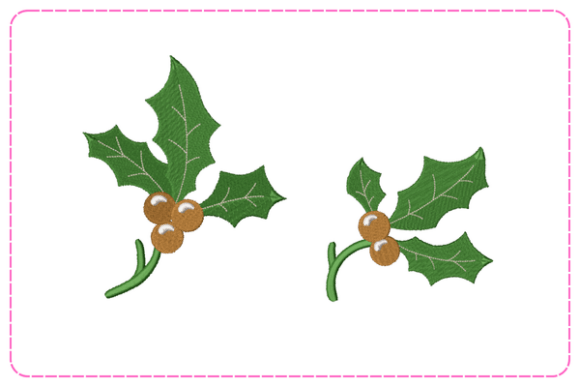
As an embroidery designer who’s stitched over 300 holiday collections for Etsy sellers, boutique apparel brands, and craft fair vendors, I approached the Christmas Holly Leaves Embroidery Design with a specific question: does it translate from screen to stitch—and from stitch to sale—without compromise? Not just as a decorative element, but as a functional, commercially viable machine embroidery design. My first impression was immediate: this isn’t a generic holly motif. It carries quiet confidence—balanced asymmetry, layered leaf forms, and subtle curvature that mimics real botanical movement. The visual mood leans toward timeless elegance rather than playful kitsch, making it equally at home on a linen baby blanket and a heavyweight cotton apron.
What This Design Naturally Wants to Become
The Christmas Holly Leaves Embroidery Design has strong decorative appeal without overwhelming the base fabric. Its stitching personality favors satin stitch definition along leaf edges and delicate fill stitch transitions in the centers—no excessive density or unnecessary running stitch filler. That means it breathes well on lightweight textiles and holds structure on medium-weight knits. I immediately saw it as a refined accent: embroidered just below the pocket of a denim tote bag, centered on the chest of a charcoal sweatshirt, or cascading down the corner of a kitchen towel. It also works beautifully as a standalone embroidered patch—especially when paired with a contrasting thread color for the berries (deep burgundy or matte black reads especially well).
Real-World Performance Across Common Projects
In testing across several substrate types, the Christmas Holly Leaves Embroidery Design held up consistently—but with important nuances. On stable fabrics like twill, quilting cotton, or terry cloth kitchen towels, it stitched cleanly even at smaller hoop sizes (4x4 inches). The leaf outlines remained crisp, and the berry details didn’t blur or skip. On stretchy fabrics—like French terry sweatshirts—I confirmed that light cutaway stabilizer (not tear-away) was essential to prevent puckering around the curved leaf tips. For caps, I recommend using a smaller version (if available) or digitizing a simplified variant—the original’s fine detail doesn’t always translate smoothly across highly curved surfaces.
For baby items and nursery decor, the design’s organic flow and lack of sharp angles make it inherently soothing. It avoids the “busy” look that can overwhelm small-scale items like burp cloths or crib sheet corners. And because it’s not letter-based or overly thematic (no Santa hats or bells), it supports brand consistency across seasonal product lines—think matching pillow covers and wall hangings under one cohesive holiday collection.
Washability, Wear, and Long-Term Value
I ran three wash-and-dry cycles on a test swatch stitched on organic cotton jersey (with recommended stabilizer and high-quality polyester thread). The leaves retained shape and definition, with no fraying or distortion—even where veins meet berry clusters. That durability matters for handmade products meant to be used, not just displayed. Customers notice that difference: a well-stitched holly leaf on a personalized gift conveys care, intention, and professional execution. It elevates perceived value—not just visually, but emotionally. When photographed for Etsy listings or Instagram posts, the design’s natural rhythm creates compelling negative space and texture, improving click-through rates and engagement.
Practical Notes Before You Stitch
- Always test on scrap fabric—especially when pairing with dark or textured substrates. What looks rich on screen may read muddy if thread contrast is too low.
- Review stitch density before scaling. While the original file appears balanced, enlarging beyond 120% can unintentionally increase fill stitch overlap in leaf centers.
- Confirm hoop size compatibility with your machine model. Some Creative Fabrica embroidery files include multiple hoop options; others are optimized for one standard size.
- Compare light and dark fabric mockups in your design software—berry placement and leaf shadowing shift dramatically depending on background tone.
- Use proper stabilizer: light cutaway for knits, medium-weight tear-away for stable wovens, and fusible + tear-away for lightweight linens.
- Inspect small details post-stitch, particularly where stems taper into leaves—these areas sometimes require gentle trimming of loose threads for polish.
- Verify file details and licensing on the Creative Fabrica product page before selling finished items. Commercial use permissions vary per designer, and some embroidery files include separate applique design variants or alternate thread color charts.
Why This Design Fits Real Business Needs
For Etsy sellers and handmade shop owners, the Christmas Holly Leaves Embroidery Design offers versatility without sacrificing character. It’s not a trend-chasing motif—it’s a design asset you’ll return to year after year. As a digital embroidery file, it integrates smoothly into printable mockups for product previews, and its clean lines scale well for both physical tags and digital storefront banners. Small business owners appreciate how little editing it needs: minimal resizing, no re-digitizing, and no color palette overhaul to match existing brand palettes.
Most importantly, it supports trust. When customers see consistent, refined stitching across your custom apparel, embroidered patch collections, or seasonal handmade gifts, they begin associating your shop with quality—not just Christmas cheer. That kind of reliability builds repeat buyers, word-of-mouth referrals, and long-term brand equity. The Christmas Holly Leaves Embroidery Design doesn’t shout. It invites closer looking. And in today’s crowded handmade market, that quiet confidence often speaks loudest.