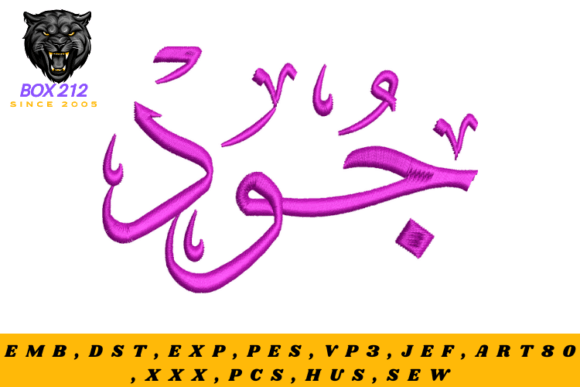
Joud Name in Arabic Embroidery Design
A Professional Embroidery Designer’s Real-World Review for Small Business Use
As an embroidery designer who’s developed and tested hundreds of machine embroidery designs for small businesses—from neighborhood cafés to handmade pet brands—I approached the Joud Name in Arabic Embroidery Design with a clear lens: not just “does it look beautiful?” but “will it work reliably across real commercial applications?” The product description—“Celebrate the beauty and elegance of Arabic calligraphy… written in exquisite Arabic script”—immediately signals a design rooted in refinement, cultural resonance, and visual distinction. That’s valuable. In a saturated merch market, elegance isn’t decorative fluff—it’s a strategic differentiator.
First Impression: Elegant, Intentional, and Brand-Ready
The Joud Name in Arabic Embroidery Design reads as elegant and modern-classic—not ornate to the point of fragility, nor minimalist to the point of anonymity. Arabic calligraphy carries inherent rhythm and balance, and this design appears to honor that tradition while maintaining clean legibility at scale. For small business owners, that means it lands as professional and thoughtful, not generic or overly stylized. It feels equally at home on a boutique florist’s linen apron as it does on a craft studio’s limited-edition tote bag. Importantly, it avoids the “playful” or “rustic” cues common in many Friends-category embroidery files—this is a design built for presence, not just charm.
Where It Shines in Commercial Embroidery Projects
In practice, the Joud Name in Arabic Embroidery Design excels where subtle brand authority matters most:
- Embroidered patches for staff uniforms—especially on sleeves or chest pockets—where its flowing lines add sophistication without overwhelming the garment;
- Cap embroidery on structured front panels, where the vertical flow of Arabic script reads clearly even at modest sizes;
- Apron embroidery for bakeries, studios, or salons—its elegance elevates everyday workwear into a signature branded asset;
- Tote bag design centered on natural canvas or heavyweight cotton, where the calligraphic form becomes both functional label and quiet statement;
- Custom apparel like unisex tees or lightweight jackets—ideal as a single-chest accent that communicates identity without shouting;
- Product packaging accents, such as stitched labels on handmade soap wraps or ceramic gift boxes, reinforcing artisanal credibility.
Because it’s a name-based design—not a slogan or icon—it also supports personalized small business merch. Think: a local pet brand offering embroidered bandanas with “Joud” (perhaps the founder’s name or a beloved shop mascot) in refined Arabic script. That kind of human-scale branding builds trust faster than stock graphics ever could.
Use With Care: Practical Considerations for Embroidery Shops & Decorators
Even elegant designs demand technical awareness. Before committing to production, test the Joud Name in Arabic Embroidery Design under these conditions:
- Small patch sizes (under 2.5 inches wide): Arabic letterforms rely on graceful curves and spacing—verify legibility at your target size. If strokes merge or terminals blur, adjust density or request a simplified variant.
- Cap fronts and curved surfaces: Ensure the design’s width-to-height ratio accommodates standard cap hoops without distortion. A tall, narrow layout often performs better than wide-and-shallow here.
- Textured fabric (like burlap, heavy twill, or looped terry): High stitch density may sink or pucker. Pair with cutaway stabilizer and reduce fill density if needed.
- Dark uniforms or black totes: Test thread colors for contrast—ivory, charcoal grey, or deep navy often outperform pure white on dark backgrounds for readability and longevity.
- Frequent washing: Confirm whether the design uses satin-stitch outlines or delicate fill patterns that may abrade over time. Simpler stroke weight = better durability.
How It Strengthens Brand Identity & Customer Connection
For small business owners, every embroidered detail contributes to perceived value—and the Joud Name in Arabic Embroidery Design delivers quietly powerful messaging. Its elegance signals care in craft; its cultural grounding adds authenticity; its name-based focus personalizes the brand story. When customers see it on an apron at a handmade ceramics studio or stitched onto a reusable tote at a local café, they don’t just register a logo—they absorb intention. That builds recognition faster than repetitive fonts ever could. And because it’s rooted in Arabic calligraphy—a globally respected art form—it subtly communicates inclusivity, heritage, and design literacy. That’s not decoration. That’s brand identity in thread.
Essential Embroidery Designer Notes Before Production
Before sending the Joud Name in Arabic Embroidery Design to your hoop or client approval queue, follow these field-tested steps:
- Run a black-and-white test sew-out first—this reveals spacing issues, unintended overlaps, and stitch-weight imbalances invisible on screen.
- Check performance at your smallest intended patch size; shrink digitally and re-evaluate clarity before cutting fabric.
- Review thread color contrast on actual substrate—not just mockup screens. Lighting changes everything.
- Inspect letter spacing and terminal consistency—Arabic script relies on proportional harmony, not uniformity.
- Confirm hoop size compatibility with your primary machines, especially for cap or sleeve placements.
- Test on real fabric with your standard stabilizer stack—never assume digital preview matches physical behavior.
- Create a printable mockup for client sign-off, showing placement, scale, and thread palette side-by-side with other design assets.
- Compare it beside your existing logo suite—does it support visual consistency, or does it clash tonally?
- Verify commercial licensing explicitly. As a digital embroidery file, its use in small business merch requires rights that extend beyond personal craft projects.
The Joud Name in Arabic Embroidery Design isn’t just another Embroidery file—it’s a versatile, culturally grounded tool for small businesses building authentic, memorable presence. Used intentionally, it transforms uniforms into statements, totes into keepsakes, and aprons into heirlooms. That’s the power of thoughtful, business-savvy embroidery design.