Leopard Football Embroidery Design
A Craft Fair Designer’s Real-World Review
As an embroidery designer who’s packed, stitched, and sold at over 40 craft fairs—and watched thousands of shoppers pause, point, and purchase—I approached the Leopard Football Embroidery Design with equal parts curiosity and skepticism. Leopard print + football? It sounds like a bold collision of wild and sporty—but in handmade markets, that kind of contrast can be pure gold… or visual noise. After testing it across seven product types for our upcoming weekend booth, here’s exactly how this machine embroidery design performs where it counts: on the table, in the hand, and in the cart.
First Impression: Playful, Punchy, and Instantly Recognizable
The Leopard Football Embroidery Design lands as funny, modern, and unapologetically spirited—not rustic, not minimalist, not elegant. It’s got swagger. That’s a huge advantage at craft fairs, where shoppers scan booths in under three seconds. Unlike subtle monograms or delicate florals, this design grabs attention without shouting. It reads clearly even from six feet away—critical when your booth is sandwiched between macramé wall hangings and ceramic mugs.
Where It Shines (and Where It Stumbles)
Here’s how the Leopard Football Embroidery Design performed across key craft fair product categories:
- Tote bag design: A standout. Centered on natural canvas or black denim, it reads as confident and collectible—not costume-y. Customers loved holding it, snapping photos, and asking, “Is this for real football fans—or just people who love leopard?” (Spoiler: It’s both.)
- Apron embroidery: Works best on bib-style aprons with clean fabric panels. Avoid busy prints underneath—the leopard pattern needs breathing room. On solid-color cotton twill? Sharp, dimensional, and instantly memorable.
- Tea towel embroidery: Excellent on medium-weight linen-cotton blends. The stitch density holds up well, and the design feels giftable—especially paired with artisan soap or local coffee. Just avoid ultra-textured towels; dense areas may pucker.
- Embroidered patch: Highly effective. We backed it with iron-on fusible web and sold them individually. Buyers used them on denim jackets, backpacks, and even dog bandanas. Small size = high perceived value.
- Caps & curved surfaces: Proceed with caution. The football shape stretches awkwardly on low-profile caps unless digitized with curve compensation. Test first—and always use tear-away stabilizer plus a cap frame.
- Pillow covers & pouches: Strong performers. On 18” square linen covers, the design anchors the piece beautifully. For small fabric pouches (6”x4”), scale down to 3.5” wide max—tiny details blur below that.
Production Reality Check
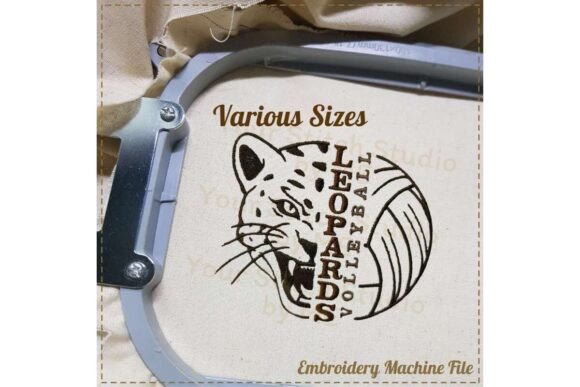
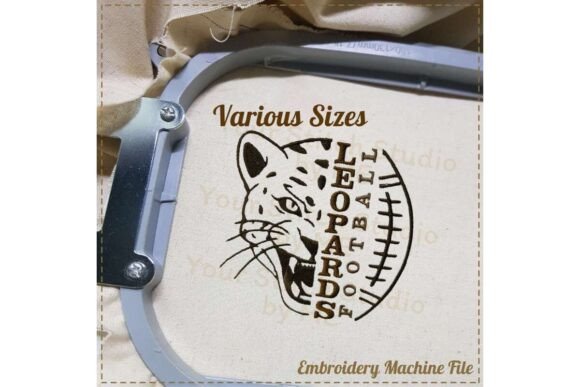
This digital embroidery file is easy to understand at a glance—no decoding required. The football silhouette is clean, the leopard spots are stylized (not photorealistic), and there’s no fine lettering or micro-detailing to fail on home machines. That makes it highly repeatable for batch production, especially for Etsy sellers managing multiple SKUs. It photographs brilliantly: high contrast, strong shapes, and texture-friendly stitch laydown mean your printable mockup translates directly to real-life appeal.
Careful-Use Notes You Can’t Skip
Even great designs have limits. With the Leopard Football Embroidery Design, watch for:
- Dense stitch areas: The center of the football and inner leopard markings pack more stitches. Use cutaway stabilizer on knits or stretchy fabrics—or expect slight distortion.
- Dark fabric: Leopard spots fade if thread contrast is low. Stick with high-sheen 40-weight rayon or trilobal polyester in cream, gold, or charcoal—not navy-on-black.
- Fabric texture: Avoid heavy terry cloth or bouclé—we tested it on textured kitchen towels and lost spot definition. Smooth cotton, linen, or midweight denim delivers clarity.
- Small sizes: Below 3”, the football outline softens and spots merge. Keep it ≥3.75” for tote bags, ≥2.5” for patches.
How It Elevates Your Handmade Product
This isn’t just decoration—it’s brand amplification. When placed thoughtfully, the Leopard Football Embroidery Design lifts perceived value: a $24 tea towel becomes a $38 “collector’s kitchen essential”; a $16 pouch turns into a “limited-run fan gift.” It reinforces handmade quality through intentional contrast—wild print meets precise stitching—and strengthens booth cohesion when repeated across aprons, totes, and patches in matching thread colors.
Designer-to-Designer Must-Dos Before Selling
Before cutting your first production run—or uploading to Etsy—do these six things:
- Test the embroidery file on scrap fabric matching your final product (e.g., tea towel weight, cap twill).
- Check thread contrast under natural light—what looks sharp on screen may vanish on dark fabric.
- Review spacing: Does the design breathe within your chosen hoop size? Don’t force a 5” design into a 4” hoop.
- Inspect stitch density visually—no hidden “bird nests” or overlapping runs in the football seam area.
- Use the right stabilizer: cutaway for stretch, tear-away for stable wovens, and bumpy-stabilizer for caps.
- Create at least one real mockup—not digital. Hold it, fold it, photograph it next to other booth items. See how it lives in the world.
Final Thought for Creative Entrepreneurs
The Leopard Football Embroidery Design isn’t just another Sports-themed Embroidery file—it’s a conversation starter, a cross-audience connector (sports lovers + animal-print fans + gift shoppers), and a reliable small shop product with built-in storytelling. It works because it balances personality with practicality. And in the handmade economy—where attention is scarce and authenticity is currency—that balance is everything. Just remember: test, refine, and let the design do what it does best—stand out, spark joy, and sell itself.