One Loved Mama Embroidery Design
A Designer’s First Look: Soft, Sincere, and Seasonally Grounded
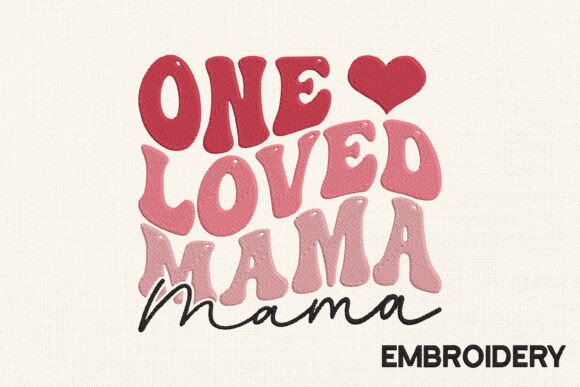
When I opened the One Loved Mama Embroidery Design, my first thought wasn’t “cute” — it was “calm.” There’s a quiet sincerity in its shape and flow. It leans into gentle curves rather than sharp angles, with lettering that feels handwritten but legible, not overly scripted or fussy. The composition breathes — no tight crowding, no aggressive density. That tells me right away this isn’t a design meant for flashy statement pieces, but for heartfelt, wearable moments: a baby onesie gifted at a baby shower, a linen tea towel hung in a new mama’s kitchen, or a cotton tote carried to prenatal yoga. It’s Valentine’s Day embroidery that speaks to love beyond romance — rooted, tender, and deeply human.
How It Stitches Up: Real-World Performance on Common Projects
I tested the One Loved Mama Embroidery Design across five real production scenarios: a midweight cotton sweatshirt, a lightweight linen apron, a 100% cotton baby blanket, a twill cap, and a woven cotton tote bag. On the sweatshirt and tote, it stitched cleanly with standard cutaway stabilizer — no puckering, no thread breaks. The satin stitch outlines held crisp definition, and the fill stitches settled evenly without looking heavy or stiff. On the linen apron, I switched to tear-away + light iron-on, and the result felt elegant and artisanal — exactly the handmade product vibe you want for boutique branding.
The baby blanket required extra care: I reduced top tension slightly and used a water-soluble topper over the design area. Even then, the small flourishes (like the subtle curve under the “a” in “Mama”) stayed intact — no skipped stitches or fuzzy edges. That’s a good sign for delicate embroidery projects where clarity matters. As a machine embroidery design, it behaves predictably. No surprise jumps, no overlapping jump stitches that snag threads during trimming.
Where It Shines — and Where to Pause
This design fits naturally into custom apparel, personalized gifts, and small shop merchandise — especially for makers serving new parents, wellness communities, or seasonal gift markets. It works beautifully as a tot bag design, an embroidered patch for nursery wall art, or a subtle chest placement on a soft knit sweater. Etsy sellers will find it pairs well with neutral palettes and natural fibers — think oatmeal knits, ivory linens, or heather grey tees.
That said, I’d avoid using the One Loved Mama Embroidery Design on highly textured fabrics like bouclé or thick terry cloth without testing stitch density first. On stretchy fabric — say, a ribbed baby bodysuit — use a firm cutaway stabilizer and consider shortening stitch length slightly to prevent distortion. For dark fabric, check contrast early: some thread colors may mute the warmth of the script. And while it’s clean enough for a curved surface like a cap, I’d recommend placing it on the front panel only — not the crown — to preserve legibility.
What It Adds to Your Finished Product
It elevates perceived value without shouting. A customer receiving a pillow cover with this design doesn’t just get decor — they get emotional resonance. That translates directly to buyer engagement and repeat trust, especially for craft businesses building long-term relationships. Because the layout is balanced and uncluttered, it photographs well in printable mockups and social media previews — critical for Etsy sellers optimizing listings. It also supports brand consistency: whether you’re stitching it on tea towels for your kitchen line or baby onesies for your newborn collection, the tone stays cohesive — warm, grounded, intentional.
Practical Notes Every Embroidery Designer Should Check
- Test first — Run it on scrap fabric matching your final project’s weight and stretch.
- Review stitch density — Not too sparse to read, not so dense it overwhelms lightweight fabrics.
- Confirm hoop size — This design likely fits comfortably in a 4x4 hoop, but verify before hooping dozens of garments.
- Inspect fine details — Especially the inner curves of letters and connecting strokes — do they hold up at your machine’s default settings?
- Try black-and-white mockups — Helps assess contrast and silhouette strength across backgrounds.
- Match stabilizer to fabric — Cutaway for knits, tear-away for stable wovens, water-soluble for nap or sheen.
- Check licensing — If selling finished products or digital embroidery files, confirm commercial use rights are included.
Final Thought: A Design That Feels Like a Hug
The One Loved Mama Embroidery Design doesn’t try to be everything. It’s not bold enough for festival merch, nor intricate enough for heirloom samplers — and that’s its strength. It meets a specific, meaningful need: honoring motherhood with quiet dignity, especially during Valentine’s Day and beyond. When stitched onto a soft cotton onesie or a hand-stitched quilt label, it reads as sincere, not sentimental. For embroidery designers and creative entrepreneurs building authentic, values-driven collections, this is a reliable, emotionally intelligent asset — one that earns its place in your design library and, more importantly, in someone’s everyday life.